FOR PARENTS
.
You're not worried about nothing. It's something.
The fear you feel about your child's future is not irrational. It is a rational response to a world that has changed faster than the systems designed to prepare children for it. Half of young adults between 18 and 29 are living back at home. Three-quarters of employers say new hires are not ready for the basic demands of a job. These are not statistics about other people's children.
“You don't need more information. You don't need a better phone app. You need a system — one that works inside the family you already have, starting with the time you already have, this week."
Start Here — Find Your Entry Point
What Does This Actually Ask of Met?
.
WHAT PARENTS SAY THEY'RE ACTUALLY AFRAID OF
Most parenting resources talk about goals and milestones. Very few acknowledge what parents are actually carrying. These three fears come up in every conversation we have with families.
"My child is going to be unprepared for a world I can barely navigate myself."
The Readiness Pack converts that vague dread into a specific, actionable list. When you can see exactly what your 10-year-old should be able to do — and they can do it — the fear has somewhere to go.
"I'm going to be supporting this adult child long after I expected them to be independent."
The Explorer-to-Capable-Adult progression is a map from where your child is now to where they need to be before they leave your home. There is a clear path. You are not navigating without one.
"I'm scared for myself — and I'm supposed to be my child's steady anchor."
The Family Council is designed to be run by a tired, stretched, uncertain parent on a Tuesday night. The system is not asking you to have it all together. It is asking you to show up consistently. That is different, and it is enough.
WHAT READIKIDS ACTUALLY PROMISES
Most parenting programs try to respond to specific fears with specific solutions — here is how to handle screen time, here is how to help with college applications. Those are tactical. ReadiKids is strategic. It is not preparing your child for the 2035 economy. It is building the human qualities that make a person functional in any economy, any relationship, any circumstance: responsibility, self-management, contribution, communication, and the ability to keep going when things don't work.
Here's the key: you control what they need and how your kids get trained. We don't tell you what to do. We give you a system to implement the way you see it works for your family. You know your kid better than anyone. You are the expert, even if you don't feel you are.
The outcome: A capable, confident, self-managing young adult who will be okay in any world — including ones neither of you can imagine yet. That is the goal. Not a perfect child. Not a guaranteed outcome. A prepared human being.
FIND YOUR STARTING POINT
The ReadiKids system grows with your child from early on through young adulthood. Find the level that matches your child's age and start there — not at the beginning, not at the end. Right where you are.
The levels are to identify the areas of development, the skills they are learning to acquire. Where is your child? The skills of a 4-year-old are different than a 9-year-old, and different from a 14-year-old. Identify the skills needed and then practice leaning the skills until ready to move on to new and greater skills. Each child has a symbolic pack they fill with these skills.
The packs are organized into three age groups: Little Explorers (birth to 10), where you find the right starting point based on what your child can already do — not their birthday. Formation Years (10–15). Launch Years (15–20). This is the starting point.
LEVEL 1
Age Group 0-10
The Readiness Pack as play. Simple, age-appropriate responsibilities — feeding a pet, setting the table, making their bed. The Family Council as a story. The first Have·Do·Become experience and exploring a new world. The desire to learn and experience new things is foremost in their minds and actions.
Highest parent activation rate
This is a period where the parents learn the traits and interests of their children, the children experience the world in little steps, and both grow together and discover each other. There is learning and experimenting in both groups to see where interests lie.
LEVEL 2
The Readiness Pack as challenge. Age-appropriate skills: managing a chore list, learning to cook a simple meal, handling a basic budget, communicating with adults. The Family Council becomes a weekly meeting with an agenda your child helps set. A time to test independence and new skills.
Skills they can demonstrate
After practicing and testing the new skills, parents may find they are amazed as what their kids can do. A teenager who takes a Family Council agenda home and runs it is having a different conversation with their family than most teenagers ever get to have.
LEVEL 3
Age Group 15-20
The Readiness Pack as preparation. Independent living, professional communication, financial management, healthcare basics. The Family Council transitions toward launch planning — what does this young adult need before they leave home?
Identity formation
It's time to assess the positioning of life readiness. Whether they have been using the system a year or fifteen, it's time for a discussion. A 17-year-old with a launch readiness plan creates conversation parents desperately want but may not know how to start.
THE HONEST ASK
Most programs never answer this question directly. We will. The ReadiKids system is designed to be implemented by a tired, financially stretched, imperfect parent on a Tuesday night — because that is the parent who actually needs it. Here is the real ask.
MINUTES PER WEEK
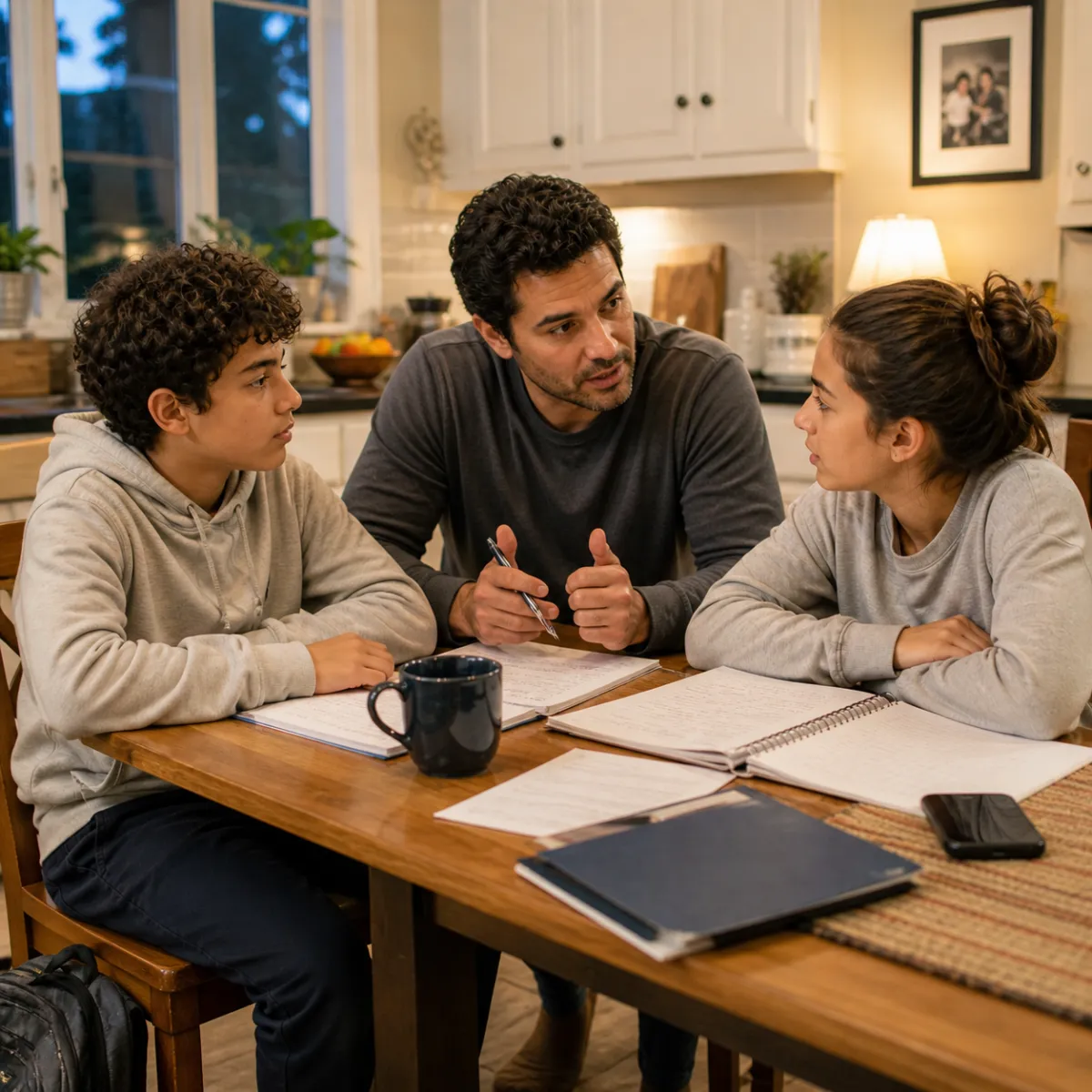
One Family Council meeting. Not a production. A structured conversation with your child about what they're working on, what they accomplished, and what the assignment is for this week. Twenty minutes. Once a week. That is the core practice.
READINESS PACK SKILL AT A TIME
The Readiness Pack does not ask you to implement 40 things at once. It assigns one skill, one routine, one responsibility at a time — appropriate to your child's age — and your child practices it until it is second nature before adding the next one.
NOT PERFECTION
You do not have to be a perfect parent. You have to show up consistently. A Family Council that happens imperfectly every week is worth more than a perfect one that happens three times a year. The consistency is the message your child receives.
"A strong child is the evidence of a steady parent. The ReadiKids system does not ask you to be perfect. It asks you to be present and consistent. That combination — available to any parent — is what builds a capable child."
— Raising Children Capable of Leaving Home
WHAT THE SYSTEM GIVE YOU
Have·Do·Become is not a philosophy. It is a description of how human capability actually develops. Children learn by having skills assigned to them, doing those skills consistently, and becoming the person who can do them without being asked. The Family Council is the governance structure that makes the practice consistent. The Readiness Pack is the progression that makes it comprehensive. Together they are a complete system — not a collection of good ideas.
The Family Council gives you a weekly, structured reclamation of your influence in your child's life — competing with nothing, canceled by no screen
The Readiness Pack converts vague anxiety about the future into a specific, completable list of things your child can actually do
The progression levels give you a visible map from where your child is today to what Capable Adult looks like — with waypoints you can celebrate along the way
The Parents United community gives your fear company — and turns it into collective action instead of isolated dread
The online platform and facilitator network give you support between sessions — so the system sustains itself even when motivation dips
CHOOSE YOUR STARTING POINT
Parents arrive at different points of readiness. Some want to start tonight. Some want to understand more first. Some want to understand what is behind the program. All three are the right way to start — pick the one that fits where you are right now.
1
READY TO START NOW
Download the Family Council Guide — a free, complete walkthrough of how to run your first Family Council with your child this week. No registration required beyond an email address. Most families who use the guide hold their first Family Council within 48 hours.
What this asks of you
One evening. One conversation. One assignment for your child. That is the first Family Council. Everything else builds from there.
2
WANT TO UNDERSTAND MORE
Start with the Have·Do·Become overview — the framework underneath everything ReadiKids does. Understand how the Readiness Pack works for your child's specific age. Read about the Family Council and why the structure matters before the content. Then find the program that fits your child right now.
What this asks of you
Twenty minutes of reading. At the end of it you will know whether this system is right for your family — and if it is, you will know exactly how to start.
3
LEARN WHAT IS BEHIND THIS
Read the Book
What this asks of you
To step into a different way of seeing their role as a parent—one that is calmer, more intentional, and more hopeful than the frantic, fear‑driven model most parents are stuck in. Be open to a new kind of parental leadership.
QUESTIONS PARENTS ASK FIRST
The honest answers.
My child is already a teenager. Is it too late to start?
No. Start at the level that matches where your child is now, not where you wish you had started. A 14-year-old beginning the Trailblazer level has four to six years before leaving home — more than enough time to build the capability that matters. The research on adolescent brain development is clear: significant character and skill formation continues through the early twenties. It is never too late to introduce structure and expectation.
I'm a single parent. Does this work for a household without two parents?
Yes, and the Family Council model explicitly accommodates single-parent, grandparent-led, and non-traditional household structures. The underlying principle — structured, recurring family communication led by an adult who claims leadership — works in any configuration. The Family Council with one parent and one child is still a Family Council. Many of the most consistent adopters of this system are single parents precisely because it gives them a clear structure rather than relying on coordination between two adults.
My partner doesn't think we need this. Do both parents have to be on board?
One committed parent running a consistent Family Council produces a meaningfully different child than no Family Council at all. Ideally both parents participate — and once a reluctant partner sees the child's response to the Family Council, engagement often follows. Start with the parent who is ready. Do not wait for perfect alignment before you begin.
We're already stretched thin. How is this not one more thing to fail at?
This is the most common fear and the most important one to answer directly. The Family Council is 20 to 30 minutes. It replaces the time you already spend worrying about your child's future with time actually doing something about it. The Readiness Pack assigns one skill at a time — not a curriculum overhaul. The system is designed to work inside your existing life, not require a new one. If you hold one Family Council this week, you have started. That is all starting requires.
Is this a religious program?
No. The ReadiKids system is grounded in research on child development, family systems, and practical capability-building — not in any specific religious tradition. Futures Fulfilled works closely with faith communities because faith communities have exceptional infrastructure for family support, but the program itself is designed for every family regardless of belief or practice. The values it builds — responsibility, contribution, self-management, character — are human values, not theological ones.
Not in a classroom. Not in a program. At home, in the daily routines and weekly conversations that shape who they are becoming. Start building it intentionally — this week.
© 2025 Syconn Solutions LLC -- All Right Reserved
Facebook
Instagram
X
LinkedIn
Youtube
TikTok